Sunday, April 12, 2020

Brian's Ghost Town Safari #4: Bridal Veil and Palmer


Some ghost towns are no more than a name on the map. In the case of Bridal Veil, though, the name’s so unique that it’s kept the place clinging on to existence by a fingernail, long after its industry and residents have departed.

Fig. 7.1: #SaveThePostOffice

Bridal Veil, Multnomah County, OR
Est. 1886, abandoned c. 1990

and

Palmer, Multnomah County, OR
Est. 1886, abandoned c. 1930s

Bridal Veil and its sister town, Palmer, were built in the 1880s by the Bridal Veil Lumbering Company for logging operations on Larch Mountain in the Columbia River Gorge. Bridal Veil was at the bottom of the mountain, on the banks of the Columbia; today its remains lie between I-84 and the Angel’s Rest trailhead. The town’s unusual name came from nearby Bridal Veil Falls, which, as implied, are misty, ethereal, and well worth a visit. “The romantically inclined never fail to name at least one waterfall in a state Bridal Veil,” notes Oregon Geographic Names. (And speaking of romantic names, there have never been true larch on Larch Mountain. The BVLC’s workers cut noble fir.)

Fig. 7.2: The flume from Palmer to Bridal Veil. Got your tube?

Palmer was a little further up the mountainside. Named after the Palmer family that had founded the company, this outpost was where logs were cut at a rough mill before being sent down an enormous wooden flume to the finishing mill, the box factory, and the main railroad tracks. (Some daredevil loggers rode the flume for fun.) Above Palmer, a private rail line operated by the lumber company wound deep into the forest. As one observer wrote:
“Its length is five miles, and it circles and twists in that distance until it resembles the trail of a mammoth serpent. It represents the most difficult achievement of the lumbermen in Oregon. The only feature of the road except the line itself resembles the ordinary narrow-gauge railroad is the 13 ton Baldwin locomotive, the power that pulls the freight. This freight consists of logs which will average of a size equal to that of the engine boiler. These logs are formed from the trees which are felled by the red shirted lumbermen in the employ of the Bridal Veil Lumber Company. After being cut, the logs are rolled to the nearest point on the railroad. They are then arranged in a line, huge staples driven in each end sections of heavy chain attached to the staples forming a train of logs. The foremost of these logs is then chained to the engine, which hauls it and its companions upon the roadbed of the line.”
Together, the twin settlements were the first company towns built in Oregon. They were real, substantial communities, with homes, churches, schoolhouses, and post offices, but apart from a couple preexisting homesteads at the foot of the mountain all the property belonged to the BVLC and the Palmers. Families could fish the Columbia or gather berries for themselves, but all other groceries and dry goods came from the company store – just like in the song. Roughly 180 employees and their families lived in this semi-feudal state.

Fig. 7.3: Bridal Veil mill and town.

Given their historic importance, Bridal Veil and Palmer have been well documented and were a lot more heavily represented in the newspaper archives than some of the other towns I’ve visited. Most of that record consists of epidemics, fires, and industrial accidents. Life in the Gorge was tough.

In 1902, a forest fire tore across Larch Mountain, completely incinerating Palmer. Two boys were killed, and the survivors only endured the blaze by huddling in the mill pond until it had passed. Within a year, however, the town had been rebuilt and was turning out lumber again.

The next tragedy struck down the mountain at the Bridal Veil train station. In 1906, the eastbound Pacific Express steam train suffered a catastrophic malfunction and began speeding uncontrollably down the track. Despite the efforts of its crew, the train came ripping into Bridal Veil and rear-ended the Spokane Flyer, then idling at the station. The Pullman car at the rear of the Flyer was “telescoped,” crushing its passengers. Bridal Veil’s residents rushed to help the victims, but with only one doctor in town and many casualties to aid, five ultimately died. Newspapers of the day recount the gruesomely heroic efforts of the Pacific Express’s locomotive crew to stop the runaway train, without which more lives would have been lost:
“While Fireman Morgan was clinging to a runaway engine and fighting his way through scalding steam to the throttle, Engineer W. H. Swain, with the flesh on his arms and hands cooked, was lying on the bumpers back of the tender striving in vain to cut the air-pipe and set the emergency brakes. Though each effort caused the flesh to peel from his hands, he remained at his post until the crash came and he was thrown off upon the ground.”
Of course, the Oregon Journal reassured readers, these brave men thought nothing of it:
“With his badly burned and lacerated head, hands and arms wrapped in bandages, Fireman Morgan was found at his home, Albina avenue, this morning. Though it was evident he was suffering much pain, the young fireman only laughed when reference was made to his heroic work on the runaway train. To him, taking his life in his own hands is a daily occurrence, and in his own eyes his conduct of yesterday was nothing unusual.”
After the rail accident, two more fires swept through the area in 1917 and 1922, although neither caused as much destruction as the 1902 blaze.

Working in Bridal Veil was dangerous, too. A minor religious celebrity, Thomas Welch, owed his career to an industrial accident on Larch Mountain. While removing broken ties from the elevated railroad trestle at Palmer in 1924, Welch lost his balance and fell fifty-five feet into the mill pond – cracking his head on the support beams on his way down. He was comatose for an hour, and during that time he went to hell.

“The Bible calls it a ‘lake of fire,’ and that is exactly what it was,” he recalled later. “It was a huge lake with little flames about six inches high, and was a blue and blue-green color.”

Welch thought he’d spend the rest of eternity there, but then he felt the presence of Jesus Christ by his side, and he promptly awakened on the floor of the mill office. (His coworkers, who’d thought he was dead when they hauled him from the pond, got a real shock.) He spent his life recounting the story of his trip to hell at church meetings and tent revivals, and he became a fixture on Pat Robertson’s The 700 Club in the 1970s.


Fig. 7.4: Scorched trees surround the railroad trestle and mill pond at Palmer, the site of Thomas Welch’s brush with the Eternal. If you look closely, you can see the train hauling a line of logs.

Like most logging operations of the era, the Bridal Veil Lumbering Company clear-cut recklessly over the years, and Larch Mountain’s old-growth forests were growing depleted by the 1930s. The Depression didn’t help the company’s finances, and labor unrest was starting to shake the old patriarchal company-town system. (The BVLC’s employees were “organized” as a local of the Loyal Legion of Loggers and Lumbermen, a powerless dummy union set up by the military during World War I; when some Bridal Veil millworkers began organizing a real, independent union in 1935, they were run out by sheriff’s deputies.) In 1936, yet another fire damaged the planing mill, and the company decided to call it quits.

The entire town was sold to – seriously – a subsidiary of Kraft Cheese. There were no macaroni dinners or Kraft Singles in the 1930s, and Kraft cheese came in wooden boxes; a company town with a preexisting box factory seemed like an ideal investment for the growing dairy company. The last remnants of Palmer, which had been in decline as logging technology evolved, were fully abandoned at this point and Bridal Veil transitioned from a lumber town to a manufacturing town. As well as cheese boxes, the company did a roaring trade in ammunition boxes during World War II, and then in doors and window sashes during the postwar housing boom. They made fruit crates, wooden toys, and mousetraps. Ironically, this sort of diversification into secondary wood products was bigged up as a solution to unemployment in rural Oregon after the lumber industry’s collapse in the 1980s, but it doesn’t seem to have been a long-term solution for Bridal Veil.

In the early sixties, the mill closed and the rapidly dying town was purchased by – seriously, again – a NASCAR driver named Hershel McGriff. He kept some people on to operate a small lumber yard, but Bridal Veil was never the same. McGriff began slowly demolishing the town’s historic buildings, initially with a view to redeveloping, but it appears he gave up on the project at some point. In 1990 he sold everything to the Trust for Public Land. The plan was to rewild the site, converting Bridal Veil into parkland that could be added to the Gorge’s recreation areas.

Fig. 7.5: The imperfectly rewilded lumberyard today.

This process has, however, been almost ridiculously slow. All the commercial buildings were torn down, despite pleas from historic preservationists, but no park development has taken place, and thirty years on the area between the mountainside and I-84 is still full of overgrown foundations and roadways. A few private homes still cling on, however, and there are some unique remains that keep Bridal Veil from being entirely forgotten.

(Hershel McGriff, by the way, is now in his 90s and still racing – he’s been recognized as the world’s oldest stock car driver.)

I drove down via the Historic Columbia River Highway (worth an excursion all its own) on a gray, drizzly weekend in January. I’d been to the site before to use the trailhead, but hadn’t had any idea there was a ghost town in the underbrush. It took a few minutes poking around to start spotting remnants.

Fig. 7.6: Two of many distressingly youthful graves.

The first is the cemetery, which I almost missed at first since it looks like it’s in a private backyard. It was a morose place. Bridal Veil is blessed with a view of the Gorge, but today the whole place hums with highway traffic from the interstate, and while the cemetery was mowed it also looked very seldom visited. It became even more morose when I noticed that most of the graves belonged to children, casualties of the diptheria epidemics of the late nineteenth century.

The little post office pictured at the top of the article is the other main survivor. Apparently, people like to have their wedding invitations postmarked “Bridal Veil” - and this is big enough business that the USPS continues to operate the Bridal Veil post office today! It was closed when I visited, but I could see through the door that it really is just a regular post office inside - PO boxes, linoleum floors, dreary federal posters and all. I noted, however, that all the electric meters and other equipment on the outside of the building were labeled as property of the City of Cascade Locks, several miles away. Bridal Veil may still exist as far as the Postal Service is concerned, but that’s about its only official status.

Fig. 7.7: The remains of Bridal Veil station today, with a petrochemical bomb train rushing by. Not to soapbox or anything, but when one of those inevitably derails in the Gorge it’s going to make that 1906 collision look like a picnic.

Beyond the post office lies a wide field of crumbly asphalt and concrete where the industrial buildings used to be. They are being overtaken by invasive blackberry bushes and some of the roads have already been covered in thick pads of moss. Heaps of more modern garbage have been left by illegal dumpers. A freight train hurtled by, carrying carloads of lumber: wood is still big business in the Northwest, but it doesn’t support as many people, or as many towns, as it used to.

I decided to look for the site of Palmer up the slope, and that’s when the real adventure started. The town had been abandoned by the 1930s, and the remnants were demolished by the Forest Service in 1944, but I had read online that its footprint is still visible if you’re paying attention. I drove up Palmer Mill Road to investigate.

Soon I began passing signs saying things like UNIMPROVED ROAD EXERCISE EXTREME CAUTION and ROUTE CLOSED IN WINTER, and the track degraded into a strip of muddy rock on the edge of a cliff. Unfortunately, by this point there was no way to turn around and I knew I just had to keep going until the road spat me out near Corbett on the mountaintop. There was no sign of the ghost town, and I quickly focused more on saving my ass as I crawled up the slope. I kept sliding backwards into my seat like I was on a roller coaster. For reference, I drive a 2008 Hyundai Elantra; while it has taken some pretty severe backroads beatings and survived, this was definitely pushing it.

Spoiler alert: I survived to get home and do some research. Apparently, a century ago, Palmer Mill Road so notoriously difficult to navigate that it was literally used by motorists to test their cars’ endurance. In 1913, a Portland auto dealer trying to demonstrate the capabilities of Federal-brand trucks brought a group of reporters on an excursion up the 30% inclines to Palmer. The headlines were glowing:

Fig. 7.8: Blatant sponsored content is nothing new.

“Any automobile that climbs the grade from the highway up this road to the town of Palmer,” asserted the Oregonian, “can qualify in the mountain goat class.” It’s official: I’m going to start calling my car the Mountain Goat from now on.

Of course, I knew none of this at the time, and spent the drive alternately cursing my bad judgment and drinking in the vistas of mist blowing through the ferns. A few miles up the goat track, I passed a homestead. There in the midst of the forest was an enormous, unpainted, lichen-coated barn and farmhouse, walled off with wire and guarded by a German shepherd who barked furiously as I passed. I noted the inhabitants’ trucks: living on a road like this, their lift kits clearly weren’t just for show.

The road eventually leveled off and pavement began to reappear. As I wound back through Corbett, I made two resolutions: to trade in the Mountain Goat for something with a higher center and four-wheel drive, and to always double-check the road conditions before my ghost town expeditions.

Friday, April 3, 2020

Brian's Ghost Town Safari #3: Tonquin


This is when I realized my hobby was getting serious.

In February, I made plans to go to the gun range with a friend. I hadn’t been shooting in a while, she’d never done it, and we’d found a discount on an introductory handgun class. It was to be held at the Tri-County Gun Club outside Sherwood, a good ways drive from our respective houses, and so as the date of the class neared I looked up the route on Google Maps to see how long it would take us to get there. Then I spotted an unfamiliar placename on the map.

Fig. 6.1: I used to work at a trucking company where Google Maps was the only website we had access to. I spent a lot of my down time exploring places like this virtually.

The greyed-out, widely kerned placenames usually correspond to places that are unincorporated and don’t have their own zip codes. Some ghost towns appear on Maps that way, and this one looked like it could be one of that species of towns that has kind of lost its independent identity and merged into the surrounding exurbia. I looked up Tonquin, Oregon, and that’s exactly what had happened. Once I saw that there was a picturesquely shabby historic building there, too, I knew we were going to have to make a detour.

Tonquin, Washington County, OR
Est. 1908

After receiving some quality firearms education (I’ll put in a plug for 540 Tactical here, I promise it’s not paid sponsorship) we drove back along SW Tonquin Road and turned left at the WES tracks. Here, sandwiched by a quarrying operation to the west and Tualatin’s new-build tract homes to the northeast, was Tonquin.

Fig. 6.2: All aboard.

Just west of the tracks, the center and raison d’être of the vanished place looms large. The Tonquin Electric Transformer Substation (as the state historic preservation office calls it) was built circa 1913 in a Spanish Revival style that might be familiar to residents of Northeast Portland. The building provided power for nearby sections of the Oregon Electric Railway, an interurban train service; it also appears to have served as a post office for the small community that sprung up around the stop.

Fig. 6.3: Check out those OG wooden louvers.

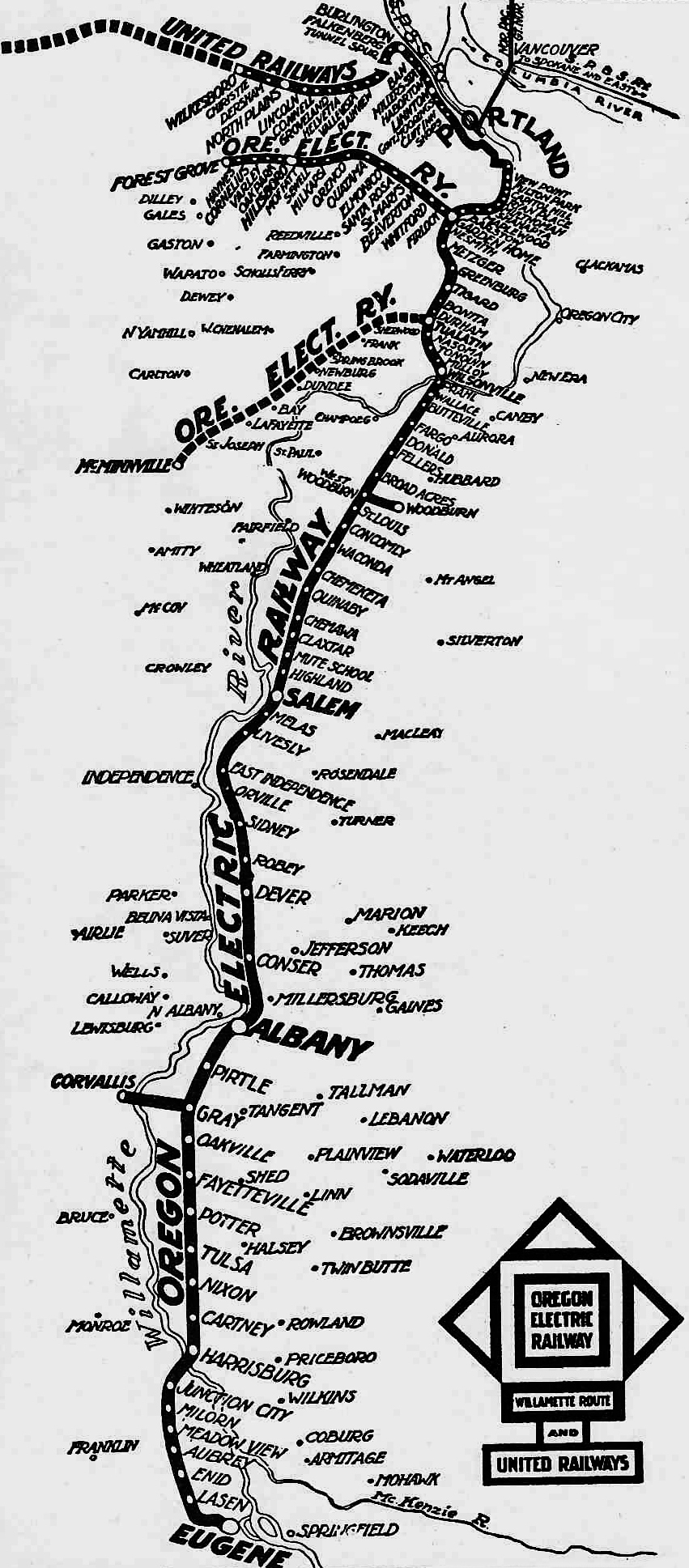
The MAX and WES systems were not the first commuter train services in the Portland metro area. You may have seen old tracks poking through the asphalt in various spots around town, but not only was the city crisscrossed with streetcars in the early 20th century, there was a whole passenger rail network spread across Western Oregon. The PEPCO line, whose main right of way is now the Springwater Corridor, spread deep into rural Clackamas County. The OER connected downtown Portland to Salem, Corvallis, and Eugene. Now, I’m not a gearhead and I’m not going to go into the details of rail gauges or different kinds of rolling stock or anything. I’m mostly interested in the social effects the trains must have had. What would it mean to be able to commute from Salem to Portland at the turn of the twentieth century? What would it be like for a rural community like, say, Monitor to be accessible by rail from the city? I’m only just beginning to learn about the topic and looking at the PEPCO and OER maps lately has been blowing my mind, not least for all the ghostly station names. (And check out this recently-made Underground-style map of all the metro area’s interurban lines.)

Before the OER was built the Tonquin area was a nameless stretch of farmland. According to my edition of Oregon Geographic Names, its very identity as a locale came straight from the railroad and its promoters: “When the Oregon Electric Railway was built in 1907-08, it was the policy of the company to establish stations with names of historic interest to Oregonians and the station Tonquin was named for the ship that brought the Astor party to Astoria.”

Not to digress too far, but the story of the Tonquin is worth retelling. New York-based fur mogul John Jacob Astor sent the ship west in 1811 to set up a trading post at the mouth of the Columbia and gather pelts for sale in China. After establishing Astoria as the first white settlement in the Pacific Northwest, they sailed north to begin trading for pelts on Vancouver Island. They never returned. Eventually, the ship’s only survivor, a native Quinault man named Joseachal who had been working for the Astorians as an interpreter, returned to the mouth of the Columbia to tell the tale.

Fig. 6.4: The Tonquin being boarded, complete with contemporary fake news chyron

The Tonquin had been commanded by one Joseph Thorn, a 32-year-old Barbary War hero whose arrogant and capricious leadership had already cost him the crew’s loyalty. Apparently, during trade negotiations with the Tla-o-qui-aht nation on Vancouver Island, Thorn had lost his temper again – fatally, this time. He smacked his interlocutor across the face with a fur. Fighting broke out and the outnumbered Astorians were quickly slaughtered. Joseachal was taken as a slave. However, one wounded man was left alive on the ship as the Tla-o-qui-aht retreated for the night. When they returned to loot the Tonquin’s stores the following day, the survivor torched the powder magazine and blew up the ship in a spectacular act of revenge. It’s a grim story – pretty far from the pleasant monikers like Springfield or Hillsdale that we usually give our planned towns – but it is interesting, I’ll give the OER that.

If we’re talking names, though, we can go further back. Astor’s ship’s name was a variant spelling of Tonkin, which was then the Romanized term for northern Vietnam: Đông Kinh. There are a million towns in the United States named after locations overseas, from Paris, Texas, to Canton, Ohio, but I’m not aware of any other placenames of Vietnamese origin. Tonquin might be unique.

Naturally, the announcement of a station serving this sleepy section of the valley led to a flurry of property speculation. An incomplete grid of numbered streets still exists around the substation today, indicating that the area was platted separately from the surrounding burghs; newspapers of the 1900s and 1910s are full of breathless advertisements and land deals. One early investor in Tonquin was A. L. Barbur, the Portland city auditor for whom the clogged artery in Southwest is named.

Fig. 6.5: Call Billy Grippo now.

The area was probably never much busier than it is today. As far as I can tell from The Oregonian’s archives, only two newsworthy events ever happened in Tonquin after the station opened. First, in 1916, a murder victim was found in a ditch nearby. Then, in 1918, there was an accident involving a pair of railroad hand carts. Two teams of workers were returning the carts to the substation at the end of the day, pumping along the tracks, when one of the men on the lead cart lost his hat and stopped the cart to pick it up. The other cart’s operators didn’t notice and kept on seesawing along until they collided. Fortunately, since they were right on the rail line, all four men could be rushed to the hospital in Portland by train. Most other mentions of Tonquin in the newspapers relate either to property sales or misdemeanor arrests.

Like many other big booms in the American West, the era of interurban rail was short-lived. Ridership on the OER peaked in 1920. As the personal automobile began its inexorable rise to domination of our built environment, rail commuter numbers tumbled across the country. (Meanwhile, the intra-urban streetcar lines that fed into them were allegedly bought up and steered into deliberate collapse by a cabal of auto manufacturers. The “streetcar conspiracy” is a very big and controversial story so I won’t get into it here. You might recognize it as the plot of Who Framed Roger Rabbit, which is probably still the best movie ever made about American transportation. I’ve always thought that if they ever make a sequel, it should be about Roger and Jessica teaming up with Jane Jacobs to stop the Lower Manhattan Expressway.)

The OER began closing branch lines in 1931 and ceased passenger service altogether in 1933, only 25 years after it opened. The Tonquin substation was abandoned and the post office closed. Overnight, Tonquin lost any pretensions of being a town. The railroad still ran through it – the OER line was operated by Burlington Northern for freight through the rest of the 20th century, and this section is now used by the WES – but trains no longer stopped. The federal government still has the name on the books as a “populated place,” but it’s not census-designated and does not have its own zip code.

Tonquin was never a major hub of activity, just a quiet spot on the fringe of the metro area with an exurban mix of residential and industrial buildings. This is what makes it an interesting variety of ghost town. It’s not that it was destroyed or abandoned, it’s just no longer as much of a distinct locale. The railroad station was the seed out of which the place grew, and it’s been disused for over a century. Sherwood and Tualatin have grown around it and blurred its borders.

If I was a real journalist or historian, and if I’d known I was going to write this, I would have stopped there a little bit longer. I’d have gone up to one of the houses across from the substation, knocked on the door, and asked if Tonquin exists as a community for its residents. Do people lend each other tools, give each other lifts, invite one another over for dinner? Are people proud to live in Tonquin? Maybe it’s not a ghost town at all, not for them. (If you know anyone who lives there, please direct them to this article!) But to the rest of the world, Tonquin, Oregon is just a label – and one absent from most maps.

Like I said, I’m not much of a rail guy, but I am kind of interested in doing some more exploration and seeing how the interurbans affected settlement, community-building, and placemaking. At some point I’m going to check out the Oregon Electric Railway museum outside Salem, and there’s supposed to be another one of these Spanish Revival substations in the similarly-faded locale of Waconda nearby. I’ve also been told there are a lot of railroad artifacts left behind on the eastern end of the PEPCO line. Like most things I’ve looked at so far on the blog, the interurbans can be a real rabbit hole.

Wednesday, March 25, 2020

Brian's Ghost Town Safari #2: Monte Cristo


Although I’ve always loved a picturesque ruin, Monte Cristo was my very first ghost town. This time last year I was living in Seattle, understandably bored; when I heard about an abandoned gold mining camp in the mountains nearby, I knew I had to take a look.

Fig. 5.1: Metal-sided garage, the oldest surviving building in Monte Cristo.

Western Washington isn’t usually associated with gold mining. You might expect a ruined prospectors’ settlement in the Sierra Nevada or the wilds of the Yukon, but not just outside the Puget Sound megalopolis – everyone knows that business around there is all trees and tech. But for a brief moment in the late nineteenth century, the desperate and credulous flooded up the South Fork Sauk River to stake their claims on a supposed fortune in gold. Unfortunately for them, it didn’t quite pan out. Pun intended.

Monte Cristo, Snohomish County, WA
est. 1893, abandoned 1980

Gold and silver were struck at the headwaters of the South Fork Sauk in 1889. At this point, though, the area was just too rugged and remote to exploit without some serious investment. The goldfields lay fifty miles east of the port at Everett, and the men who found them had to go cap in hand to East Coast industrialists in order to secure funding for a railroad. John D. Rockefeller – the Standard Oil monopolist who was at this point reaching his apogee as the richest human being in history – was one of those who lent out his capital. The tycoon’s name was magnetic and once it emerged that he was funding the project, thousands of people began trooping up the Sauk to file their own claims, sure that Rockefeller couldn’t pick a bad bet.

The Eastern investors and lone prospectors alike dug their mines high in the mountain peaks, and cable cars were built to lower the ore into the valley below for processing. A village soon sprung up around the mills and concentrator at the headwaters of the Sauk. Monte Cristo was a typically seedy boomtown full of grifters eager to “mine the miners.” The venality, violence, drunkenness and sexual exploitation were probably as bad as what you see today in the fracking camps of Canada and the Dakotas; it’s what happens when there are lots of single men making money very quickly in isolated surroundings. The only difference was Monte Cristo’s literary pretension. The main drag was Dumas Street, and the intersecting avenues had names like Mercedes and Dantes.

Fig. 5.2: Monte Cristo in 1895, looking like a big snowy logjam.

The most famous of Monte Cristo’s crooked merchants was one Frederick Trump, a Bavarian immigrant who had fled to America to evade the draft. In the 1890s, he was living in Seattle, where he ran a combined diner, saloon, boardinghouse and brothel called the Dairy Restaurant. When he heard about the strike on the Sauk, he figured astutely that the only people who usually get rich out of a gold rush are the outfitters and pimps. (This is a lesson I had hammered into me again and again living in Seattle, which first really prospered as a metropolis by fleecing would-be prospectors heading to the Yukon.) Moving to Monte Cristo, Trump jumped somebody else’s claim and built a “hotel” (read: brothel) on his squatted property. Despite being an obvious crook, he became the town’s most prominent citizen, and he was soon elected justice of the peace. If the story sounds familiar, it’s because his grandson Donald managed a similar trick on a grander scale a century later.

Fig. 5.3: Frederick Trump, patriarch and pimp.

Life in Monte Cristo was never pleasant and it soon grew worse. Rockefeller took greater and greater control of the town, elbowing out the other investors and cracking down on labor agitation. The heavy annual rain- and snowfalls destroyed rail lines and buildings every winter, making the mere survival of the town Sisyphean. Worst of all, after only a few years it became clear that the gold deposits were much more meager than initially thought – not to mention heavily leavened with naturally occurring arsenic.

By the turn of the 20th century, many of the town’s residents, including Frederick Trump, had abandoned ship. (Trump went on to repeat his Monte Cristo business model during the Yukon gold rush. He became a wealthy man and moved to New York to start a family. The rest is, unfortunately, history.) In 1903, Rockefeller and his underlings sold the entire mining operation to the American Smelting and Refining Company. ASARCO, the source of the Guggenheim family fortune, is now primarily known as one of America’s worst industrial polluters; fully twenty of its former properties are now Superfund sites and it has been held liable for negligently poisoning dozens of communities across North America with lead and arsenic emissions. As I’m sure you’ve noticed so far, this is an extremely Gilded Age story.

The only part of the Monte Cristo operation the Guggenheims really wanted was the smelter at the end of the railroad line in Everett. (It’s now one of their twenty Superfund sites.) The town was surplus, and was treated as such. Monte Cristo dwindled to a ruin. In 1920, the last operating mine was buried by a massive avalanche.

However, the end of one industry was the birth of another. With its beautiful mountain setting and backdrop of romantic ruins, Monte Cristo became a resort attraction almost immediately, and remained so for much of the twentieth century. The hotel was renovated and opened for motorists touring the newly built Mountain Loop Highway. Visitors could stay in cabins and enjoy the area's hiking trails; the town is adjacent to the Gothic Basin, which is supposed to be spectacular. Its remoteness and the yearly weather damage, however, soon took its toll. By 1980 the resort had deteriorated into a shabby mess at the end of a long, poorly maintained track; that year, a heavy flood of the South Fork Sauk washed out the road link completely and the county refused to rebuild it, effectively terminating Monte Cristo as a habitable community. Three years later, the abandoned lodge burned to the ground. Looters and treasure hunters ripped up most of what was left.

Fig. 5.4: Vacation cabins and mining debris at Monte Cristo today.

Through the efforts of concerned locals and the Trust for Public Lands, the townsite was eventually transferred to federal ownership. The US Forest Service became the official custodians of the surviving vacation cabins, thousands of pounds of ruined mining equipment, and several mines and their associated piles of arsenic-contaminated tailings. A few houses on the edge of town, however, remained in private hands. The site is now being actively preserved through a public-private volunteer partnership.

My friend and I visited on a mild, overcast day in early June. We parked at the Gothic Basin Trailhead and attempted to find the trail to town. Unfortunately, there have been so many separate roads built through the valley, and the course of the South Fork Sauk has changed so many times, that we ended up just walking up the stony riverbed most of the way. As we hiked the four miles in, we spotted the washed-out county bridges – now sitting useless in the middle of the river – and began to see scraps of the old mining railroad exposed among the rocks.

Fig. 5.5: A path.

A little later, we passed a denuded hillside above the river. A sign identified it as “The Repository.” The Forest Service had finally buried the last of the poisonous mine tailings under this slope in 2015. The decontamination project had required waiving laws in order to construct a heavy trucking road through the Henry M. Jackson Wilderness, which surrounds the Monte Cristo townsite. Building a necessary road in a necessarily roadless area is a classic example of the contradictions sometimes inherent in caring for our environment and fixing humanity’s mistakes. Once, while working on a trail crew, I was asked to fell an enormous old-growth tree – an organism probably 300 years old. We were using it to build a series of puncheon bridges on an impassably boggy section of wilderness trail. Normally, I’d see cutting old-growth in this day and age as blasphemous and disgusting. But there was no way to pack construction materials for the bridges into the backcountry, and if we hadn’t built the bridges hikers and equestrians would have fanned out across the area to evade the bog, creating desire paths, trampling vegetation, and causing erosion. Did we do the right thing? These are the kind of difficult calls land management professionals have to make daily. (I’ll have to talk more about the experience of felling a tree in a later post.)

As we got to the four-mile mark, we were surprised to find a modern house, complete with satellite dish and a truck outside! A sign explained that there were still a few private “donut hole” inholdings on the edge of town, and reminded us to keep to USFS property. It seems absolutely inconceivable that someone could live there. I don’t know how you could get even a robust 4WD truck up the riverbed, but I guess if you had a house here before it became inaccessible, there wouldn’t be any way to make a profit by selling it, so you might as well keep it as an off-grid vacation property.

The ghost town proper started a little further on. Someone had set out the old lodge sign as a welcoming signpost. After passing it, mine carts and other bits of debris started appearing in the underbrush. The vacation cabins, of which there are maybe a dozen or so, began in a clearing, alongside an enormous (and still functioning!) railroad turntable.

Fig. 5.6: We didn't touch it, but when we passed by on our way out some young kids were spinning it around, without even a rusty squeak.

The foundations of the burnt-out lodge were a little further back into the woods. There was no trace of the concentrator, Trump’s brothel, or most of the other 19th-century buildings. Only one structure from the gold camp era, the garage pictured above, is still standing. Walking up to the trail signposted “Dumas Street” you can see why. There are some plaques denoting where major structures used to be, and in a lot of cases there's nothing behind the sign but a sheer drop. The destructive power of nature is palpable all throughout the valley. I’m sure if I visited again in twenty years, the landslides and floods would have made the landscape visibly different.

Monte Cristo is a pretty standard example of my vague ghost town hypothesis: communities created by the profit motive in defiance of environmental conditions are not sustainable in the long run. But on the other hand, in terms of its unusually intact buildings and its wealth of well-preserved artifacts, it’s an exceptional standout and well worth a visit.

Monday, March 16, 2020

Brian's Ghost Town Safari #1: Champoeg


If you think Americans today move around a lot, try reading Honey in the Horn by H. L. Davis. He portrays the twentieth century dawning over a population completely adrift. In Davis’s Oregon, caravans of fortune-seekers, entire towns’ worth, pour over the mountains from West to East and back again seeking better land. Schemers plot out competing, fantastical cities on paper in order to win the favor of the railroad surveyors. The novel’s young protagonists, Clay and Luce, join crowds of itinerant laborers, hop-pickers, farmhands, and outlaws who pass by each other again and again on the backroads of a country already half-abandoned.

In a lot of ways, the book is about the stubborn refusal of Western settlers to truly settle – to adjust to their new environment and build a community of dwellers in the land, instead of just constantly looking for greener pastures. One throwaway joke line which stuck with me comes from Clay and Luce’s time on the coast. After living off the bounty of the land for months, they stop at a hotel in Coos Bay on their way inland which has a different culinary philosophy. “The next morning there was a restaurant breakfast which, because the natural products of that country were beef, elk, venison, honey, wild-fowl and two hundred species of edible fish, consisted of ham, eggs, pancakes and maple syrup.” No locavores, these pioneers!

(I have tons to say about the book, it’s really snidely funny and is one of my all-time favorites, please get @ me in the comments if you’ve read it and pick it up if you haven’t.)

Fig. 4.1: It's not quite as sexy as this cover makes it look, although it has a couple moments.

Davis’s observations about the transience of settlement in the American West are spot on. This side of the Mississippi, the continent is scattered with hundreds of ghost towns. Each one was once people’s home, before something – usually, from what I’ve seen, the profit motive running up against environmental conditions and creating disaster – forced the residents back on the road. People ate ham instead of fish, or whatever, and disaster followed. Residents scattered, and in many cases, thriving communities ceased to exist overnight. It was a level of mobility and instability hard to imagine even today.

I’ve been fascinated by ghost towns for a while, but I’ve recently started actively seeking them out, and I plan to record my finds on this blog. I’ve visited eight or so thus far in Oregon and Washington, and I have many more lined up – there’s no danger of running out.

Oregon is thought to be the nation’s ghost town capital, although counting ghost towns is practically impossible since there’s no strict definition of one. Some places popularly deemed ghost towns are thriving villages whose population has merely fallen from boomtown heights. Others are areas of wilderness with not a crumb of rubble to be seen. Very few are clusters of intact, standing, and completely vacant buildings, although of course those are the most fun. One website I’ve found uses lists of extinct post offices to estimate an Oregon ghost town count of over 1,600. However, that list includes places like the city of Albina, which was incorporated into Portland and still exists as a neighborhood, so it’s probably way too expansive.

In any case, this isn’t really a catch-em-all hobby; it’s a way to get outside, see new places off the beaten track, and learn some history. Let’s start with my New Year’s visit to the granddady ghost town of them all…

Champoeg, Marion County, OR
Est. c. 1829, abandoned 1861

Fig. 4.2: Bustling downtown Champoeg, pictured from the corner of Napoleon and LaSalle.

Now, Champoeg wasn’t the first settlement in what was then called the Oregon Country. Astoria had been founded in 1811, and the Hudson’s Bay Company had already begun building its network of trading posts – and there were hundreds if not thousands of Native towns and villages scattered across the country from the boreal forests to the high desert. When French-Canadian HBC trappers arrived in the Willamette Valley, they encountered temporary Kalapuyan encampments along the river, including near what became Champoeg.

If the trappers had asked, they might have been told that building a permanent village at the place the Kalapuya called čʰámpuik wasn’t the soundest idea. Naturally, they didn’t ask.

Today, the uninhabited floodplain is designated as a State Heritage Area. I visited on December 30th, at the tail end of 2019. It was one of those days when you really, really need to get out of town and see some green along with the gray. I got a pleasant surprise on the way over when my GPS informed me that the village’s Anglicized name is pronounced “shampooey.” “CHAMPOEG FOR MY REAL FRIENDS, REAL POEG FOR MY SHAM FRIENDS,” I yelled at the steering wheel. (I do a lot of enthusiastic yelling when I’m driving alone.)

The Newell House, a Champoeg-era home and museum not far from the townsite, was closed that day. It’s privately run by the Daughters of the American Revolution, and they do what they want. The state park, though, was wide open for the curious.

Writing thirty years ago, travel writer Ralph Friedman described the park’s Visitor Center as one of the best museums in the state. His claim holds up, although I assume a lot of the digital interactivity came after he drove through. I was outnumbered by friendly docents and given free rein to explore.

The story of Champoeg – and the reason it’s a State Heritage Area, unlike most of the other sites I’ll be covering – is really the story of how Oregon went from a being a Mad Maxian free-for-all to having an organized government. In the early 1840s, the “Oregon County” was just a set of lines on a map. There were people here, and there was a thriving Cascadian biosphere that roughly overlapped with those artificial lines, but there was no polity to speak of. Under the terms of an 1818 treaty, the area was “jointly occupied” by America and Britain, but that didn’t mean anything in practice – neither country collected taxes, provided services, or really exercised any control there at all. The native nations that had traditionally owned the land were undergoing hideous demographic and societal collapse from epidemic diseases, not that the rising tide of white settlers would have abided by their laws anyway. It was a total power vacuum.

Fig. 4.3: Map of the Oregon Country showing competing American and British claims and the network of HBC trading posts. Image created by user Kmusser on Wikipedia, licensed under the Creative Commons Attribution-Share Alike 2.5 Generic license.

The closest thing to a ruling power in the Oregon Country was the Hudson’s Bay Company. A fur-trading monopoly that owned much of what is now Canada, the HBC was supposed to be an arm of the British crown but in practice operated independently like a cyberpunky corporate government, with its own money and its own courts. Its trading posts were the main centers of power in the region, and its Chief Factor John McLoughlin, based at Fort Vancouver – today’s Vancouver, Washington – was half-seriously called the “King of Oregon.”

(In case you’re curious, the HBC lost its government monopoly and its quasi-statehood in 1869 but kept on trucking; it currently exists as a bougie department store chain in Canada. They bought Saks Fifth Avenue in 2013.)

Along with McLoughlin and his underlings, there were a few hundred settlers living in the Willamette Valley. Many were former HBC employees of Québécois or Métis origin who had left the company’s service to build lives of their own. Some were affiliated with the Methodist Church, which had sent a mission to minister to the native population. Others were independent Anglo-American homesteaders who harbored hopes that this land would eventually become US territory.

Before long, this scattered community of rugged individualists started to run into the kind of problems that required a legal framework to deal with. A man named Ewing Young died without heirs, leaving behind an enormous herd of cattle and a profitable sawmill for his neighbors to fight over. Wolves and other predators attacked livestock and required collective action to fight off. Somebody committed murder. At first, these issues were dealt with via ad hoc meetings, but soon the settlers of the Willamette Valley began to realize that – as we say – they lived in a society.

In 1843, about a hundred people convened at Champoeg to discuss forming a government. The tiny settlement, at this point consisting of little more than an HBC grain warehouse, was the most central and convenient gathering point in the territory, and men rode in from distant farms for the meeting.

The debate over organizing a government had already developed along national lines. Most of the Americans resented the power of the Hudson’s Bay Company and mistrusted the Catholic, Francophone John McLoughlin. Some wanted their own government in order to prepare for annexation by the United States, while others dreamed of an independent Pacific Republic, but they were united in their belief that some kind of civil authority was necessary. The Canadiens, on the other hand, were concerned about the legal implications of instituting a government. Would they be considered rebels against the British crown if they voted in favor? If Oregon was annexed by America, would they be granted citizenship, and would they be granted title to their land? (Remember, without laws, everyone was effectively squatting on stolen property at this point.)

Fig. 4.4: Joe Meek raises a point of parliamentary protocol with his coonskin cap.

According to legend, it was Joe Meek who forced the issue. Meek, a onetime independent trapper and “mountain man,” had settled in the Tualatin Valley with his Nez Perce wife and children a few years earlier and enjoyed wide respect among both the American and Canadien communities. As the debate dragged on, Meek grabbed a stick, drew a line in the dirt and said, in a weird mixture of call-to-arms and Robert’s Rules procedurese: “Who’s for a divide? All for the report of the committee and an organization follow me.” The men formed up on either side of the line, and the vote was tallied: 52 for, 50 against. The Oregon Provisional Government was born.

As I’m sure you’ve noticed, the whole story has an odor of patriotic foundation myth to it. It may have been set up that way intentionally by the pro-government side: Ralph Friedman refers to Meek’s theatrics and the vote as a “well-organized spontaneous demonstration.” This was an era when the small communities of white people on the frontier thought of themselves consciously as historical actors and believed their personal choices could shape the lives of millions of people yet unborn.

I stepped out of the Visitor Center, exchanging some cheerful Happy New Years with the docents, and started down the hill to the floodplain and the site of that fateful vote.

In the wake of the vote, Champoeg grew slowly as power and population concentrated in Oregon City upriver. The town at the falls of the Willamette was soon the Provisional Government’s meeting place and the center of all business and political activity, and would remain so until American annexation in 1848 and its eventual eclipse by Portland and Salem. By 1860, Champoeg was a backwater, with a population of about 180 and a small economy based on the warehousing and shipment of grain. The village might still exist today as a quaint tourist attraction… if its founders had platted on higher ground.

Today, the Willamette’s volume and flow are controlled by a score of dams. Like most of the nation’s major rivers it is a combination power generator, irrigation ditch, and freight highway, run like an organic machine by a half dozen governmental agencies. But in the mid-nineteenth century, it was still wild, and in particularly wet years, it would flood – sometimes spectacularly. 1861 was one of those years. That spring, the snows in the mountains melted, the rain poured down, and the river rose, overtopping the banks and scattering the rude wooden buildings of Oregon’s first capital.

This is why the Kalapuya hadn’t built permanent settlements right on the riverbanks.

No one was killed, but the village was completely destroyed and was never rebuilt. Today, what was once downtown Champoeg can only be identified by the hollow courses of its streets and by a series of regularly spaced wooden posts, each one marking the location of an intersection.

Fig. 4.5: Looking down Napoleon Street, the main drag. Some of the roads were named after French national heroes, some after American presidents – Champoeg was an international community.

The day I visited, the townsite was mostly deserted, and the river lay low and leaden below the banks. A few old couples walked dogs along the paved paths. I tried to follow the old streets, and the tall grass soaked my pants. Just west of “downtown,” the ground rose slightly to a plateau forested with enormous trees. Apparently, this is where the fateful divide took place all those years ago.

Two Canadiens, Étienne Lucier and François X. Matthieu, had been the swing votes that day – they’d joined the Americans in voting for government while the rest of their countrymen voted against. Matthieu, a carpenter, was a political fugitive and a longtime admirer of American law and values. He’d been involved in the 1837 Lower Canada Rebellion against British rule over Québec, and after its failure had spent the intervening years hiding out on the frontier. Lucier, a former HBC trapper, was a founder of Champoeg and may have been the first white settler in the Willamette Valley. He was less radically inclined, but over the previous winter, he and Matthieu had become close friends. In the latter’s memoirs, he recalls winning Lucier over to his brand of pro-American republican politics – and thereby takes credit for deciding the vote and creating the Provisional Government.

Subsequent generations of Oregonians took Matthieu at his word. By coincidence, he happened to live longer than any other participant in the meeting, and until his death in 1914 he was celebrated as the “hero of Champoeg” who “saved Oregon for the United States.” In 1901, forty years after Champoeg’s destruction, Matthieu returned to the townsite amid pomp and circumstance to dedicate a memorial to himself and the others who voted with him.

Fig. 4.6: Supposedly, the little obelisk sits exactly where Joe Meek drew his line in the dirt, although they were working off of the octogenarian Matthieu’s memory when they erected it so I’d take that with a grain of salt.

Let’s assume the story is true and that Matthieu really did swing the vote. Did that act alone “save Oregon for the United States”? I’m not much of a Great Man historian, and I suspect that the outcome would have looked the same no matter what the tally had been that day. There were more and more Americans coming into the Oregon Country every year, while the HBC was already losing its sway in the British Empire and would have trouble getting any government backup for its interests. The demographics made the formation of a government only a matter of time; if it didn’t happen at Champoeg that day it would have happened the next time the settlers convened to solve a problem.

The more interesting question is what that government’s purpose would have been. Most of the Americans involved in the Provisional Government saw it as a step towards annexation, and indeed that’s what happened; Britain and America finally divvied up the region and by 1848 began exerting state power. But there was also a faction led by mountain man Osborne Russell that advocated dropping the “provisional character” of the government and declaring a free Republic of Oregon. The idea was that both the American and British metropoles were too far away to govern the country effectively, and that the community of settlers had already organized themselves as a sovereign body, drawing political legitimacy only from themselves. Russell ran a close second in the Provisional Government’s first gubernatorial election. Even John McLoughlin started expressing interest in independence as his influence with the British government collapsed. However, every successive wagon train brought more American patriots, and Oregon independence soon became a fringe idea.

An independent state in the Northwest may not have been a total impossibility, though. In the 1840s, there was still widespread anti-expansionist sentiment back in the United States, usually coming from Whigs who predicted (correctly) that it would inflame tensions over slavery. President James K. Polk, whose political project the Oregon Treaty was, was only elected by a hair. If a different American administration had disclaimed interest in the territory, maybe the jilted settlers would have been more interested in Russell’s ideas. An 1840s Oregon Republic would be no Ecotopia, of course; it’d be a violent settler state just like the Republic of Texas or like America itself. But in the longer term an independent Oregon may have been able to avoid the extractive, quasi-colonial relationship with the industrial East which the American West had to endure in our reality...

(As a side note, President Polk was married to Joe Meek’s cousin. I know the population was drastically smaller back then and everybody knew each other, even Presidents and mountain men, but I kind of want to believe that this is evidence that the Champoeg meeting was part of a long, stage-managed American imperialist conspiracy. It would make a fun Pynchon novel or something.)

I headed back upland. There was one part of the park left to see.

Fig. 4.7: Not gonna lie, this barn got me excited.

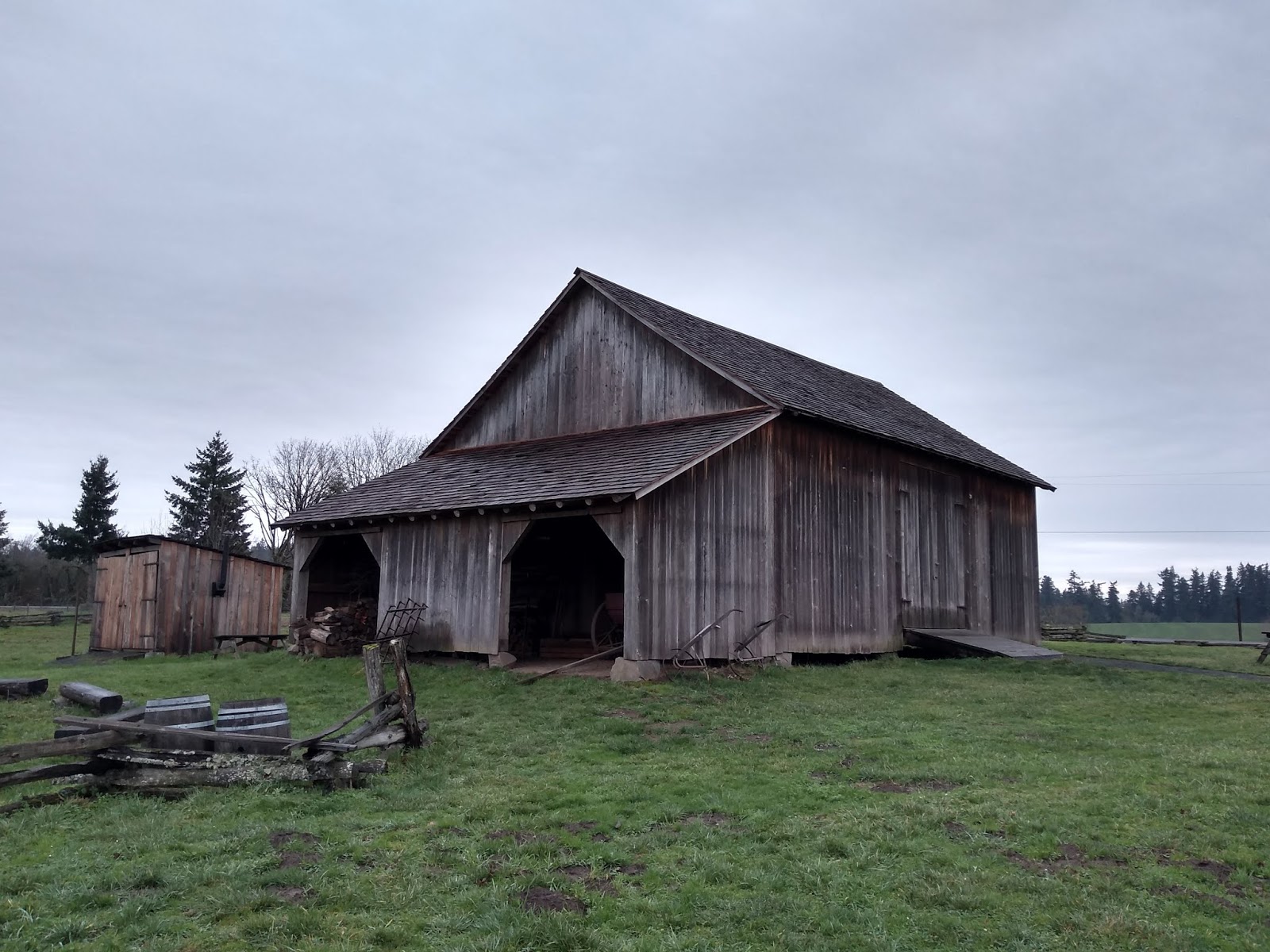
Outside the Visitor Center stands Champoeg’s only surviving building. The barn, raised by pioneer Donald Manson and his family immediately before the flood, was knocked off its foundations by the rising waters, but it was washed up downstream intact and was eventually hauled to higher ground and restored. There are a few other artifacts remaining: scraps of pottery and other archaeological remnants can be seen at the Visitor Center, and active archaeological work on the townsite is ongoing. Additionally, the community’s church bell was salvaged from the river and is now in use at the chapel in Butteville, just down the road.

Seeing the bell would have been the logical next stopping point had I planned this trip in advance and not driven down in the afternoon on a day when everything was closed. I may have to go back, see the Newell House, and slide into Butteville to check out the church and buy a Gatorade at the oldest operating store in Oregon. (Butteville’s bodega was founded in the 1860s by none other than François Matthieu.) Hit me up if you want to come – I’ll be ghosting every weekend.

Tuesday, May 7, 2019

Primitivism and Deep Ecology

This fortnight's post is a little different. Among the many fascinating blog series over at Sea Lion Press, home of alternate history publishing, is one by their author David Hoggard examining unsuccessful or fringe political ideologies. I contributed a guest article to the series this Friday (Other Ideologies: Primitivism), and I thought I'd link it here.

The notion that industrial civilization is not worth the benefits didn't originate here in the Northwest. Nor is its story confined here. Yet while researching the article, I returned to our neck of the (old-growth) woods time and time again. Earth First!, the ecological monkeywrenchers who gave us tree-sits and tree-spiking, did some of their most famous work in the timber belt of Oregon and Northern California. Their descendants in the ELF torched McMansions and GMO crops in the suburbs of Portland and Seattle. John Zerzan, the original anarcho-primitivist, lives and teaches in Eugene. A little further inland, in the mountains of western Montana, Ted Kaczynski hid from society as he built his bombs.


One of the central paradoxes of the Northwest is that we are close to, and often reverent of, nature and yet the economy built here after white settlement has been dominated by extractive industry. That is not an irreconcilable conflict - as I'll cover in later posts, loggers have often considered themselves stewards of the land - but it is difficult to deal with for many people. It's easy to feel disgust and anger at the sight of clearcuts or dams or vistas of suburban shitboxes encroaching on what still feels like a very wild place. Combine that with the Western USA's history as a breeding ground for wild ideas of all political stripes and you get the perfect recruiting ground for anti-civilization radicals.

That's my psychoanalytic introduction - now pop on over to Sea Lion Press and learn the harder facts.

Monday, April 22, 2019

Thornton Creek


Every place has its story. Even the suburbs.

I live a few blocks inside Seattle’s city limits. The double yellow line on NE 145th St separates the Emerald City from the quiet residential community of Shoreline, and even downtown Lake City has a strong suburban flavor to it. The area just south of the neighborhood was home to both an elaborate Prohibition-era speakeasy operation and a historic civil rights campaign against a racist restaurant, both of which I’ll be writing about in future posts. But Lake City proper’s main claim to fame is hosting some of the oldest continuously operating dive bars in Seattle. There won’t be a period drama set here anytime soon.

History isn’t just thrilling stories, though: it’s about how people have lived and worked and loved and struggled every day. Instead of tracing a narrative story, this week I decided to take a walk that would show me new parts of my neighborhood and allow me to give some little vignettes about what Shoreline and North Seattle are like, and how they got that way. I was going to follow Thornton Creek.

Fig 3.1: It was also a really nice day out, so I needed an excuse for a walk.
Thornton Creek drains twelve square miles of city and suburb in Seattle and Shoreline, including almost all of Lake City. After an intensive restoration campaign in the 2000s, about ninety percent of it is aboveground, which is pretty remarkable for an urban river and makes it easy to walk along even when it disappears into private property. One branch flows from Shoreline south, the other flows east from underneath the Northgate Mall, and they converge in a specially constructed flood-control park before issuing into Lake Washington at Matthews Beach. I couldn’t follow both routes, but the North Branch was the obvious choice. Northgate is about as historically interesting as a mall can get – it was one of the first enclosed shopping centers in the United States, and Ted Bundy used to pick up his victims in the parking lot – but that’s still not saying much, and besides, the route of the North Branch is longer and more varied. I got on the bus and headed to Ronald Bog Park.

The Thornton Creek Watershed is originally home to the Xacuabš (Lake People), now part of the Duwamish tribe. A village was located on the lake at the mouth of the creek, the bogs at the creek’s headwaters were harvested for cranberries, and controlled burns were used to create hunting meadows all across the watershed. If you’re ever in the area, the Shoreline Historical Society has a beautiful hand-painted map of North Seattle as it appeared before colonization, which is worth the visit alone.

The Xacuabš were dispossessed and driven off their land by white settlers in 1854, and since then the story has been one of continuous construction and rising population density. The latest chapter was visible immediately when I arrived at Ronald Bog Park.

Fig. 3.2: Notices of Proposed Land Use Action are the Seattle area’s answer to red phone boxes or Benson Bubblers.
Two signs, listing far out into the sidewalk, notified passersby that the park will be undergoing some changes. A good chunk of it will be converted into artificial wetlands in order to “mitigate” the destruction of wetlands elsewhere. In a few years’ time, city engineers will be laying light rail tracks along the other side of the freeway, grubbing up boggy habitats as they extend the train up to Shoreline. Even development that’s good for the planet in the long run, like public transit infrastructure, can be pretty destructive in the moment.

Ronald Bog Park was quiet this Sunday afternoon. A couple snoozed on the grass. Ducks paddled on the water. An old man with a beard and bucket hat cooled his feet in the pond, Thornton Creek’s headwaters springing up between his toes. The cherry blossoms were out.

 You wouldn’t know it looking at the smooth green lawn, but this area was once a true cranberry bog, covered in peat moss and grazed upon by deer and bears. In the 1940s, a peat mining operation dug up most of the moss (leaving a hole that the pond fills today), and within a few years it became an urban wilderness, overgrown and contaminated by spillover from the Shoreline dump then located immediately to the south. It wasn’t until the 70s that neighbors got it cleaned up and parkified.

I hoped to find a way out through the park to the south, where Thornton Creek emerged from the pond, so I plunged into the remaining overgrown boggy area on the eastern edge, up against the highway. The ground bristled with poky dead reeds and Himalayan blackberry. A collapsed barbed-wire fence no longer marked the boundary between park property and the domain of the Department of Transportation; the highway was so close that I could’ve scrambled up and stood on top of the concrete berm. I couldn’t see a way south. The tents and tarps of a small encampment were visible through the trees in this jurisdictional limbo, complete with a handmade bridge across a drainage ditch and gates built from orange construction webbing. Even here, eleven miles from downtown Seattle, the housing crisis is plain as day.

Fig. 3.3: A quiet corner of the park.
I decided I’d have to circle the park instead. Back on N 175th St, a gargantuan sign welcomed me to the City of Shoreline, Incorporated 1995. Incorporated 1995 it might have been, but this has been a commuter suburb since long before that date. The interurban from Seattle to Everett used to run right through this neighborhood. Like so many other transit systems of the early 20th century, though, it fell afoul of mismanagement, the Depression, and – if you believe the story – General Motors’s nefarious plot to wipe out trolleys across the nation. Ronald Bog was de-bogged by the development generated by one light rail line, and is now being re-bogged to mitigate the construction of another. It’s a neat little historical poem.

Fig. 3.4: You can tell I posted this a little late. The park's statues were still dressed up for St. Paddy's when I went through.
South of the park, Thornton Creek begins its flow underground. I walked along Meridian Ave, dipping in and out of tidy culs-de-sac that had once been dump, but not seeing a sign of the stream yet. People were out working on their cars or yards in the sun. A girl was biking in circles in the street; a few blocks over, a bald man was doing the same. Every other household seemed to have a home improvement business: there were vans belonging to plumbers, landscapers, solar panel installers and even a chimney sweep. On Corliss Place, I finally spotted the creek bed running through a landscaped front yard.

Just as it hits daylight, though, Thornton Creek disappears again into forbidden property: a tangled stretch of woods posted with NO TRESPASSING and NO DUMPING signs. Through the trees, I could see the low bulk of the Shoreline Recycling & Transfer Station. Not wanting to have to circle around on Meridian again, I looked for a back way in, but all I found was a cell tower and a desolate park.

Fig 3.5: Fifteen-foot trees growing through the tennis court at James Keogh Park.
The signs on the other side of the woods, by the bustling entrance to the recycling station, caught my eye. One was dotted with lichen devouring the black paint of the letters, while the other had the pre-2006 insignia of King County on it.

King County was organized in December 1852 and named after then-Vice-President-elect William Rufus DeVane King. A Southern plantation owner and slaveholder, King is best known for founding Selma, Alabama, and for probably being James Buchanan’s lover. (The two men spoke about each other in terms that would be sweetly endearing if they weren’t the people they were.) King was dying of tuberculosis in Cuba when he won the election. He expired only two days after returning to the United States. As a closeted Romantic consumptive and a hideous racist, King is probably our most nineteenth-century Vice President.

It took 134 years for Seattle-metro officialdom to recognize that honoring a proud defender of slavery wasn’t a very good look. The solution was brilliantly simple: they kept the name King County, but proclaimed that it now referred to Martin Luther King, Jr., instead. It was another 20 years before they got the designation officially recognized by the State of Washington and the logos updated to match. I’m almost certainly going to do a post on the Guerrilla Theater of the Absurd when I get back to Portland, and you’ll see how surprisingly controversial honoring MLK could be in the 90s.

(The county councilman who led the renaming effort, by the way, was Ron Sims, who later served as Obama’s HUD secretary and ran for Governor on a platform of fixing Washington’s grossly regressive tax system – unfortunately he was less successful in the latter effort.)

Fig 3.6: Urban wilderness.
Thornton Creek runs somewhere underneath this zone of civic infrastructure. I walked through a grassy park bounded by the Metro bus garage and a clutch of humming electrical transformers, my eyes peeled for open water.

As it turned out, I wouldn’t see the creek again for a while. It emerges on private property and remains there for the next mile, tracing a property line between people’s backyards and the interstate. As I walked through more suburban streets, smiling at the cherry blossoms and getting scowled at by two men washing a vintage car, I spotted snatches of ivy-coated gully behind fences. I was too far back to see the flowing water, and it was too close to the interstate to hear it.

The creek became public property again in Twin Ponds Park. Now this place was bustling. A junior soccer game was in progress. Less competitively inclined kids were scrambling over the huge banks of tree roots that lined the ponds. A dad was trying to play frisbee while smoking a cigarette: an athletic feat I hadn’t seen since college.

Fig. 3.7: A Twin Pond.
On the southern edge of the park, where the creek jogged back to join the freeway, I spotted the first signs of watershed volunteerism: the Washington Native Plant Society had been by to replace invasives. This walk could easily have been a trudge along a culverted dump, and the fact that it was a fun adventure instead is due to volunteer effort. If you're in the area, you can get involved with the Thornton Creek Alliance; if not, your local watershed probably has a similar group that could use your help.

Once I emerged on NE 145th St I’d reached the city limits. Seattle was right there on the other side of the street. The interstate was in sight, too, and I was about to get a new perspective on my local exit. Walking through highway infrastructure, even when it’s built with pedestrian accommodations, is always an uncomfortable and revelatory experience. It’s an ecosystem built for a different species, larger, louder, and tougher than human beings. I had diesel fume flashbacks to walking on the barricaded bridges during the anti-Trump rallies in Portland, and dodging big rigs on my way to work at a freight company off Columbia Boulevard. In my hustle across the overpass, I didn’t even stop to take a picture.

Catty-corner across the highway, I followed the creek down the edge of the Jackson Park Golf Course. The highway faded to a low growl and the scenery to pleasant monotony. On my left, a fence shielded me from errant balls; on my right, the creek ran by in the underbrush. I passed two joggers. Someone had chalked an enigmatic face on a beech.

Fig. 3.8: Shielded from balls and pinecones.
The creek eventually passed beneath me into the golf course, and I had to continue on alone until I reached Jackson Park proper. By the time we were reunited, the creek was lined with signs warning of invasive New Zealand mud snails. These tenacious bastards are about 1/5 of an inch long and are so tough they can survive passage through animals’ digestive tracts. They are hideously prolific. In New Zealand their numbers are kept down by an unlikely hero – a parasitic nematode called Microphallus which sterilizes snails – but elsewhere in the world they’ve become a hazard to local mollusks and to the fish that depend on them, including our own salmon species.

Here at the end of the golf course, the creek plunged into a deep gully of apparently public land; I tried to follow it but quickly got stuck in the mud. There was no trail here. Lost golf balls sank inexorably beneath the skunk cabbages. I scrambled up a slope, found myself in a community garden, kicked the mud off my shoes and headed onwards.

Fig. 3.9: No, I didn't pose the ball.
I liked the next neighborhood immediately. Technically, I live here, since the boundaries of the Olympic Hills neighborhood reach over to Lake City Way, but the enormous trees and pleasantly dated houses over here look nothing like the view from my apartment. I wondered idly if these trees might be old-growth that escaped logging because of the hilly terrain. Probably not. I spotted the only political sign of my walk here – a stakeboard for Trotskyite city councilor Kshama Sawant, who doesn’t represent this district – and one of the houses had an enormous, handmade wooden halfpipe in the driveway, disintegrating under a coat of pine needles. I’d like to settle down in a neighborhood like this.

Fig. 3.10: The Olympic Hills.
The creek had disappeared again, this time into a wildlife reserve that wasn’t open to the public, so I didn’t get another glimpse until it emerged from a condo parking lot at 15th Ave. From here on, it was visible in backyards and side yards, and unlike up in Shoreline it wasn’t buried in a government gully next to the highway. It divided some properties in two, and people had put up little bridges across it and pulled up lawn chairs beside it.

By the time I reached the commercial strip on Lake City Way there was already a blue note in the afternoon sun. The little wedge of park across from Wendy’s, where Thornton Creek plunged down into a ravine again, was almost twilit. This park was the first place I’d seen the creek when I first moved into the neighborhood, and it was as much of a hideous mess as always. Native plants choked out by Himalayan blackberry, branches hacked off to stobs, Fireball bottles and busted shoes and Top Ramen flung everywhere, Satanic glyphs painted on the trees. I assume that the little ravine park’s seclusion and its proximity to a big, filthy strip of fast food outlets means that cleaning it is a Sisyphean task for the Thornton Creek Alliance.

Fig. 3.11: I didn't stand in the grove for very long.
The creek runs under Lake City Way (under Pacific Northwest Flooring and its weird brick monolith, specifically) before plunging on into more residential neighborhoods. Lake City Way started life as a nineteenth-century logging road, and it’s still unusually wiggly for a major right of way.

Heading down NE 117th, now more than halfway to my destination and on a steep decline towards the water, I spotted the first really ugly houses I’d passed so far: skinny new builds with hard angles, gravel yards, and oddly scattered windows. I don’t need to include a picture. You know what I’m talking about.

What I do need to include a picture of is the sight that awaited me at the bottom of the hill: a giant vulva, kitted out for Saint Patrick’s Day and spouting out a stream of road reflectors. I’m not sure whether they’re meant to be love beads, a golden shower or a leprechaun’s treasure.

Fig. 3.12: The little text on the inside says "No New Taxes - Bush." Get it?
This incredible piece of public art is officially a commentary on the creeping forces of real-estate homogenization represented by the ugly houses up the street – the Showbox is a historic theater downtown, currently slated for demolition despite fierce protest from Seattleites, and the pun is obvious – but its origins are a little smaller-time. The owner was slagged off by his neighbors for leaving two giant stumps in his yard, so he decided to turn them into something they could really complain about.

A few blocks past the roadside attraction, I came to Thornton Creek’s confluence. The North Fork, which I’d just walked, and the South Fork, fed by parking lot runoff and the ghosts of Bundy victims, converge here in Meadowbrook Park. I’ll let Meadowbrook speak for itself. It was beautiful, and it’s the only park I’ve ever visited that requires a diagram to explain.


Figs. 3.13 - 3.15: Ahhhh.

By this point, my legs were getting sore. I’m not in great shape these days, and it felt good to have some muscles working besides my typing fingers. The sun was setting, and the neighborhood was quiet. A clutch of high schoolers were standing in a driveway, passing a basketball back and forth. As I passed, one was pretending to walk away in mock disgust at his friend’s joke. “Shit,” he realized, turning around. “I don’t have a car.”

A few more steep drops later and I hit Sand Point Way, North Seattle’s westernmost arterial, and only a block or two down that I spotted signs for Matthews Beach Park. Not too long ago, this was the site of the Xacuabš village, home to the people who walked the creek every day on their way to pick cranberries at the bog.

Tonight, families were packing up their Sunday picnics, and two friends were hauling their canoe ashore. I’d reached Lake Washington at last, three hours and eight miles later – and just in time for sunset on the Cascades.